Regulation of proliferation, migration, invasion, and apoptosis in LPS-induced fibroblast-like synoviocytes by astragalus polysaccharide via the EGFR/MAPK signaling pathway
Abstract
This study investigated the effects of astragalus polysaccharides on proliferation, apoptosis, migration, invasion, and epidermal growth factor receptor (EGFR)/mitogen-activated protein kinase (MAPK) signaling pathway in human rheumatoid arthritis fibroblast-like synoviocytes (MH7A cells). MH7A cells were randomly divided into control, lipopolysaccharide (LPS), and astragalus polysaccharides (50, 100, and 200 μg/mL) groups for experimental investigation. Cell viability significantly decreased when the concentration of Astragalus polysaccharides exceeded 200 µg/ML; therefore, a dose ≤200 µg/mL was selected for subsequent experiments (p<0.05). Compared with the LPS group, astragalus polysaccharides groups showed reduced cell viability, increased apoptosis rates, and decreased migration and invasion rates (all p<0.05). Furthermore, EGFR expression and the relative expression of p-P38MAPK/P38MAPK were both reduced (both p<0.05). In conclusion, astragalus polysaccharides may inhibit LPS-induced proliferation, migration, and invasion of fibroblast-like synoviocytes by suppressing the EGFR/MAPK signaling pathway, while promoting apoptosis.
Introduction
Rheumatoid arthritis is a systemic autoimmune disease primarily characterized by chronic erosive arthritis. Its global prevalence is approximately 0.5% to 1%, with the peak onset occurring between the ages of 45 and 60 (Venetsanopoulou et al., 2022). The disease remains persistent and refractory to treatment, characterized by pathological features including inflammatory cell infiltration, excessive proliferation of synovial cells, and pannus formation, leading to progressive cartilage and bone destruction, ultimately resulting in joint deformities and loss of function (Mueller et al., 2021). Fibroblast-like synoviocytes (FLS) plays a crucial role in the progression of rheumatoid arthritis. These cells, which are located in the synovial lining layer, are responsible for the inflammation of the synovium and the subsequent erosion of bone and cartilage. In rheumatoid arthritis, FLS exhibit tumor-like behaviors, such as uncontrolled proliferation, migration, invasion, and resistance to apoptosis, which contribute significantly to the disease's chronic progression and joint damage (Wu et al., 2021; Qian et al., 2024).
The EGFR/MAPK pathway is one of the classical signaling cascades involved in bone formation and resorption and plays a crucial role in the pathological process of rheumatoid arthritis (Luo et al., 2023). Elevated expression of the epidermal growth factor receptor (EGFR) is closely associated with fibroblast-like synoviocytes (FLS) proliferation. EGFR is a transmembrane receptor tyrosine kinase that, upon binding with EGF, undergoes phosphorylation, thereby regulating cellular proliferation and differentiation (Lahoti et al., 2014; Chen et al., 2022). Mitogen-activated protein kinase (MAPK), a serine/threonine kinase widely expressed in the body and consisting of three kinase complexes, includes P38MAPK, which is known to regulate FLS proliferation and differentiation (Zou et al., 2016).
Currently, conventional therapeutic approaches for rheumatoid arthritis include conventional synthetic disease-modifying anti-rheumatic drugs, nonsteroidal anti-inflammatory drugs, glucocorticoids, biologic disease-modifying anti-rheumatic drugs, and targeted synthetic disease-modifying anti-rheumatic drugs. These treatments effectively alleviate inflammation and pain while slowing joint damage. However, long-term use of these drugs may lead to adverse effects such as gastrointestinal ulcers, bleeding, and osteoporosis, highlighting the urgent need to identify efficient, low-toxicity plant-based medications for rheumatoid arthritis treatment (Bergstra et al., 2023; Burmester et al., 2023). Previous research has demonstrated that natural polysaccharides, an active component of plant medicines, exhibit significant anti-rheumatoid arthritis effects, including the inhibition of joint and synovial inflammation, modulation of immune cell balance, regulation of cellular energy metabolism, and bone protection. Astragalus, often referred to as the "Immortal herb for tonifying Qi," contains the active compound astragalus polysaccharide, which has been extensively recognized for its anti-inflammatory and other biological activities (Zheng et al., 2020; Ren et al., 2023). Previous studies have demonstrated that astragalus polysaccharides can inhibit the molecular activity of the MAPK signaling pathway induced by receptor activator of nuclear factor κB, thus suppressing osteoclastogenesis and mitigating lipopolysaccharide (LPS)-induced inflammatory bone resorption (Yang et al., 2021). Additionally, astragalus polysaccharides may exert pro-apoptotic and anti-inflammatory effects in IL-1β-induced FLS cells through the phosphoinositide 3-kinase/protein kinase B/mammalian target of rapamycin pathway, thereby slowing the pathological progression of rheumatoid arthritis (Meng et al., 2017). However, no studies have yet investigated whether astragalus polysaccharides can regulate FLS proliferation, migration, invasion, and apoptosis via the EGFR/MAPK signaling pathway.
Therefore, the objective of this study is to explore the effects of astragalus polysaccharides on the proliferation, migration, invasion, and apoptosis of LPS-treated FLS cells through the EGFR/MAPK signaling pathway, providing experimental and theoretical support for the clinical application of astragalus polysaccharides in the treatment of rheumatoid arthritis.
Materials and Methods
Cell Lines, drugs, and reagents
Human rheumatoid arthritis-FLSs (MH7A) were obtained from Cobioer Biosciences CO., Ltd (cas: CBP61649). The injectable astragalus polysaccharides (national medicine approval number Z20040086) were purchased from Tianjin Cinorch Pharmaceutical Co., Ltd. Trypsin, LPS, high-glucose DMEM, CCK-8 reagent, and annexin V-FITC cell apoptosis detection kits were all sourced from Shanghai, Biyuntian Biotechnology (cas: C0201, ST1470, C2701, C0038, C1062M). Fetal bovine serum (cas: SA201.02) was purchased from Cell-max (Beijing) Co., Ltd. The cell migration and invasion stain kit (for Transwell) (cas: G4740) was provided by Beijing Solarbio Science and Technology Co., Ltd. RIPA lysis buffer (Strong), BCA protein quantification kit, and FDbio-Femto ECL chemiluminescent kit (cas: FD009, FD2001, FD2008) were obtained from Hangzhou Fude Biotechnology Co., Ltd. Antibodies against EGFR, P38MAPK, and p-P38MAPK were purchased from Wuhan ABclonal Biological Technology Co., Ltd. (cas: A11351, A5049, AP0526). Goat anti-rabbit IgG was obtained from Wuhan Keri Biotechnology Co., Ltd. (cas: KR0023).
Screening of optimal astragalus polysaccharides concentration
FLS in the logarithmic growth phase were digested with 0.25% trypsin, and the cell density was adjusted to 1×10⁵ cells per well. The cells were then seeded into a 96-well plate and allowed to adhere overnight. Based on a study, the initial astragalus polysaccharides concentration range for FLS treatment was determined (Meng et al., 2017) and further refined to the following concentrations: 0 (control group), 50, 100, 150, 200, 250, and 300 μg/mL. Each concentration was tested in triplicate, with exposure times set at 24 and 48 hours. After the treatment period, the original culture medium was aspirated, and 100 μL of fresh serum-free medium containing 10%CCK-8 reagent was added to each well. A blank control group, which included no cells or astragalus polysaccharides but only fresh serum-free medium containing 10%CCK-8 reagent, was also established. After 1 hour of incubation, absorbance at 450 nm was measured using a microplate reader. Cell viability was calculated using the following formula:
Cell viability (%) = [(Aexperimental well - Ablank well) / (Acontrol well - Ablank well)] × 100%
Cell model construction and grouping
In accordance with a study (Bao et al., 2026), when the FLS reached 80% confluence, they were passaged and cultured overnight. Once the cell confluence reached 60%, the cells were treated with 2 μg/mL LPS for 3 hours to establish a cell model that promotes proliferation and inhibits apoptosis. FLS in the logarithmic growth phase were seeded into 96-well plates at a density of 1×10⁵ cells per well. After 24 hours, the cells were divided into the following groups: a control group (regular culture), a LPS group, and astragalus polysaccharides groups at different concentrations. With the exception of the control group, the remaining four groups were pretreated with 2 μg/mL LPS for 3 hours. After LPS pretreatment, the old medium was discarded. The LPS group was then supplemented with complete culture medium, whereas the astragalus polysaccharides groups were treated with complete culture medium containing 50, 100, and 200 μg/mL astragalus polysaccharides, respectively.
Cell viability assessment by CCK-8
FLS in the logarithmic growth phase were seeded into 96-well plates at a density of 1×10⁵ cells per well, with 100 μL of cell suspension per well. After 24 hours of incubation, the old medium was removed, and the cells were washed three times with phosphate-buffered saline. The appropriate culture medium was then added to each group, and the cells were incubated at 37°C with 5%CO₂ for either 24 hours (at the end of the drug treatment) or 48 hours (24 hours post-drug treatment). Following incubation, 100 μL of 10%CCK-8 reagent was added to each well, and the cells were incubated for an additional 1 hour under the same conditions. The absorbance at 450 nm was measured using a microplate reader to determine the cell viability.
Cell migration ability assessment by scratch assay
FLS in the logarithmic growth phase were digested with trypsin and resuspended in complete culture medium to achieve a concentration of 1×10⁵ cells/mL. The cell suspension was seeded into 24-well plates, with 1 mL of suspension per well. After cell attachment, the appropriate culture medium was added according to the experimental groups, and the cells were incubated for 24 hours. Once the cell confluence reached over 90%, a sterile 200 μL pipette tip was used to create linear scratches on the cell monolayer, guided by a ruler to ensure three parallel scratches. After scratching, the wells were gently washed three times with PBS to remove any detached cells. The medium was then replaced with fresh serum-free culture medium, and initial images were captured immediately using an inverted microscope. Three fixed fields of view were selected and marked for each group to ensure consistency. The cells were further cultured at 37°C with 5% CO₂, and images were taken again at the same positions after 24 hours (at the end of drug treatment) and 48 hours (24 hours post-drug treatment). The same magnification and lighting conditions were maintained throughout the imaging process. ImageJ software was used for quantitative analysis of the images, measuring the scratch width at each time point and calculating the cell migration rate. The formula for cell migration rate is as follows:
Cell migration rate (%) = (Scratch width before culture - Scratch width after culture) / Scratch width before culture x 100%
Cell invasion ability assessment by Transwell assay
FLS in the logarithmic growth phase were treated with the appropriate culture medium according to the experimental groups. The cells were digested with 0.25%trypsin at 37°C for 2-3 min, and the digestion process was terminated by the addition of complete culture medium. The cells were then resuspended in PBS, and the concentration was adjusted to 1x10⁵ cells/mL. A volume of 100 μL of the cell suspension was added to the upper chamber, and the cells were incubated at 37°C with 5%CO₂ for 24 hours. After the incubation period, the upper chamber was removed, and the non-invasive cells on the upper surface of the membrane were gently wiped off with a cotton swab. The invasive cells on the lower surface were fixed at room temperature with 4%paraformaldehyde for 20 min, followed by three washes with PBS. The cells were then stained with 0.1%crystal violet for 15 min and washed with double-distilled water until the background was colorless. The mem-brane was then carefully excised and placed onto a microscope slide, and mounted with neutral gum. Invasive cells were randomly photographed from five fields of view under an inverted microscope (100x mag-nification). The number of invasive cells was quantified using ImageJ software. The invasion rate was calculated using the following formula:
Invasion rate (%) = (Number of cells in experimental group / Number of cells in control group) × 100%
Apoptosis detection by flow cytometry
FLS in the logarithmic growth phase were digested with trypsin and resuspended in complete culture medium to generate a cell suspension at a concentration of 1×10⁵ cells/mL. The suspension was seeded into 6-well plates, with 1 mL per well. After cell attachment, the appropriate culture medium was added according to the experimental groups, and the cells were incubated for 24 hours. Following incubation, the cells were digested with 500 μL of trypsin without DMEM, and the cell pellet was collected. In strict accordance with the kit instructions, 5 μL of annexin V– astragalus polysaccharides was added to the cell suspension and gently mixed, followed by incubation at room tempera-ture in the dark for 15 min. Subsequently, 10 μL of propidium iodide working solution was added, and 400 μL of 1x binding buffer was used for dilution. The samples were incubated on ice in the dark for up to 1 hour. Apoptosis was assessed using a FACS Calibur flow cytometer.
Protein expression analysis by Western blot
FLS in the logarithmic growth phase were digested with trypsin and resuspended in complete culture medium to prepare a cell suspension at a concentration of 1×10⁵ cells/mL. The suspension was seeded into 6-well plates, with 1 mL per well. Once the cells adhered, the appropriate culture medium was added according to the experimental groups, and the cells were incuba-ted for 24 hours. After incubation, the cell pellet was collected, and total protein was extracted. Protein concentration was determined using the BCA protein assay kit, following the manufacturer’s protocol. The proteins were then loaded onto an SDS-PAGE gel, subjected to electrophoresis, and transferred to a membrane. The membrane was blocked with 5%non-fat milk. The primary antibodies (anti-EGFR, anti-P38MAPK, and anti-p-P38MAPK) were applied, and the membrane was incubated overnight (12-16 hours) at 4°C with gentle agitation. After incubation with the pri-mary antibodies, the membrane was incubated with secondary antibodies at room temperature for 60 min. Chemiluminescence was detected using ECL reagents, and the images were captured using a gel imaging system. Grayscale values were quantified using ImageJ software.
Statistical analysis
Statistical analysis was performed using SPSS 23.0 software. The normality of the continuous data was assessed using the Shapiro-Wilk test, and homogeneity of variances was evaluated with Levene’s test. Differences between groups were analyzed using one-way ANOVA, with subsequent pairwise comparisons conducted using the SNK-q test. A significance level of α = 0.05 was adopted.
Results
Effects on FLS proliferation and toxicity
CCK-8 assay results indicated that, compared to the control group, astragalus polysaccharides at concentrations of 250 μg/mL and 300 μg/mL progressively inhibited cell viability (p<0.05) (Figure 1A-B). This trend was consistent at 24 and 48 hours of intervention, with a more rapid decline in cell viability observed at 48 hours (p<0.05). To minimize the impact of drug toxicity on the experimental outcomes, subsequent experiments were conducted using astragalus polysaccharides concentrations of 50, 100, and 200 μg/mL, with a 24-hour treatment duration.
Figure 1: Effects of different concentrations of astragalus polysaccharides on fibroblast-like synoviocytes (FLS) viability after 24 hours (A) and 48 hours (B) of intervention. Effects of astragalus polysaccharides on LPS-induced proliferation of FLS after 24 hours (C) and 48 hours (D) of intervention; Data are mean ± SD; n=3; lipopolysaccharide (LPS)
Effects on LPS-induced FLS proliferation
The cell viability of FLS in the control group, LPS group, and astragalus polysaccharides (50, 100, and 200 μg/mL) groups differed significantly, as determined by one-way analysis of variance (ANOVA) (p<0.05) (Figure 1C-D). Further pairwise comparisons indicated that, compared to the control group, cell viability in the LPS group, as well as the astragalus polysaccharides (50, 100, and 200 μg/mL), was significantly increased (p<0.05). Furthermore, when compared to the LPS group, a linear decrease in cell viability was observed with increasing astragalus polysaccharides concentrations (p<0.05).
Effects on LPS-induced FLS migration and invasion
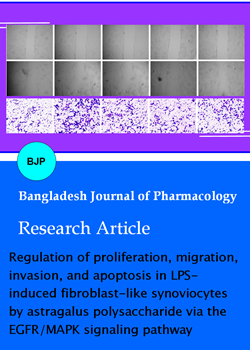
The scratch assay demonstrated that, compared to the control group, the migration rate of FLS in the LPS group was significantly increased at both 24 hours (p<0.05). However, astragalus polysaccharides treatment significantly inhibited the migration of LPS-stimulated FLS (p<0.05) (Figure 2A). The Transwell assay further revealed that, compared to the control group, the invasion rate of FLS in the LPS group was significantly higher (p<0.05). In contrast, astragalus polysaccharides intervention at all concentrations significantly reduced the invasion rate of FLS (p<0.05) (Figure 2B).
Figure 2: Effect of astragalus polysaccharides (APS) treatment on the migration abilities (A), invasion abilities (B) and apoptosis rate (C) in LPS-induced fibroblast-like synoviocytes (FLS); lipopolysaccharide (LPS)
Effects on LPS-induced FLS apoptosis
Flow cytometry analysis revealed that, compared to the control group, the apoptosis rate of LPS-induced FLS was significantly reduced (p<0.05). In contrast, treatment with astragalus polysaccharides significantly increased the apoptosis rate of cells (p<0.05) (Figure 2C).
Effects on EGFR expression and p-P38MAPK/P38MAPK relative expression in LPS-induced FLS
Western blot analysis revealed that, compared to the control group, the expression of EGFR was significantly upregulated in the LPS group (p<0.05). Similarly, the relative expression of p-P38MAPK/P38MAPK was significantly increased (p<0.05). However, astragalus polysaccharides treatment significantly downregulated both EGFR expression and the relative expression of p-P38MAPK/P38MAPK in FLS compared to the LPS group (p<0.05) (Figure 3).
Figure 3: Effects of Astragalus polysaccharides (APS) treatment on the expression of proteins related to the EGFR/MAPK pathway in LPS-induced FLS; lipopolysaccharide (LPS)
Discussion
Astragalus polysaccharides, a major bioactive compound, has been shown to regulate various cellular processes, such as proliferation, migration, invasion, autophagy, apoptosis, and pyroptosis (Zheng et al., 2020). This study demonstrates that astragalus polysaccharides can inhibit LPS-induced FLS proliferation, migration, and invasion, and promote LPS-induced FLS apoptosis. These results are consistent with previous research on another active component of astragalus, astragaloside, which were shown to suppress FLS proliferation through regulation of the LncRNA S56464.1/miR-152-3p/Wnt1 signaling axis (Cui et al., 2023). Another in vitro study further confirmed that APS promotes apoptosis in rat-derived synovial cells, accompanied by corresponding changes in the expression of the pro-apoptotic protein Bax and the anti-apoptotic protein Bcl-2 (Jiang et al., 2010).
Previous studies have revealed that severe synovial inflammation, driven and sustained by interactions between FLS, osteoclasts, and immune cells, plays a central role in the pathogenesis of rheumatoid arthritis (Komat-su and Takayanagi, 2022; Henry and O'Neill, 2025). FLS exhibit unique biological characteristics in rheumatoid arthritis, including high proliferative capacity, invasiveness, cellular heterogeneity, and resistance to apoptosis. Therefore, targeting the abnormal state of FLS in astragalus polysaccharides is crucial for the relief and treatment of the disease. In this study, LPS-stimulated FLS were used as the cell model, as prior research has shown that LPS can induce synovial cells in vitro to exhibit characteristics typical of rheumatoid arthritis (Wu et al., 2020). Treatment with astragalus polysaccharides, one of the key active components of astragalus, effectively reversed LPS-induced abnormalities in FLS proliferation, migration, invasion, and apoptosis. These results provide an experimental foundation for the clinical use of astragalus polysaccharides in rheumatoid arthritis therapy.
Additionally, this study found that astragalus polysaccharides inhibit the expression of key signaling molecules in the EGFR/MAPK pathway. EGFR is a critical upstream factor in the EGFR/MAPK pathway, possessing tyrosine kinase activity. Upon binding with its ligand EGF, EGFR undergoes phosphorylation, activating downstream signaling cascades. This pathway is a key regulator of cell proliferation (Yuan et al., 2013). Previous studies have shown that in rheumatoid arthritis patients, the expression of ligands such as EGF and transforming growth factor-α (TGF-α) is significantly elevated in synovial tissue and synovial fluid, leading to EGFR overexpression. The sustained activation of the EGFR/MAPK signaling pathway transmits signals from the cell surface receptors to the nucleus, promoting cell proliferation and differentiation through the regulation of downstream effector molecules, thus contributing to the onset and progression of rheumatoid arthritis (Chen et al., 2022; Liu et al., 2024). Further studies have demonstrated that antibodies induced by EGFR mimetic peptides can reverse the abnormal proliferation, migration, invasion, and apoptosis of FLS caused by EGFR variant III (Niu et al., 2018).
MAPK, a member of the serine/threonine kinase family, plays a critical role in various biological processes, including cell proliferation and apoptosis. In the context of doxorubicin-induced cardiotoxicity and isoproterenol-induced cardiac fibrosis, astragalus polysaccharides and astragaloside IV have been shown to exert inhibitory effects through the p38MAPK pathway and reactive oxygen species-mediated MAPK activation, respectively (Cao et al., 2014; Dai et al., 2017). Moreover, a study demonstrated that interference with the expression of downstream signaling molecules in the EGFR/MAPK pathway can inhibit the proliferation and migration of rheumatoid arthritis-FLSs (Liu et al., 2018).
Conclusion
These findings suggest that EGFR, p-P38MAPK expre-ssion, and the EGFR/MAPK signaling pathway are active regulators of rheumatoid arthritis-FLS cell function. The effects of astragalus polysaccharides on LPS-induced FLS cell function are likely mediated through the modulation of signaling molecules within the EGFR/MAPK pathway.
Ethical Issue
The guidelines about the development, acquisition, authentication, cryopreservation, and transfer of cell lines between laboratories were strictly followed. Besides, microbial contamination (commonly mycoplasma), characterization, instability, and misidentification were considered seriously.
References
Bao, ZM, Hou ZM, Jiang L, Li WY, Zhang ZX, Liu DZ, Yuan L. Effect and mechanism by which Pterocarya hupehensis Skan total flavonoids regulates the proliferation, migration and apoptosis of fibroblast-like synoviocytes. Chin J Tissue Eng Res. 2026; 30: 816-23.
Bergstra, SA, Sepriano A, Kerschbaumer A, van der Heijde D, Caporali R, Edwards CJ, Verschueren P, de Souza S, Pope JE, Takeuchi T, Hyrich KL, Winthrop KL, Aletaha D, Stamm TA, Schoones JW, Smolen JS, Landewe RBM. Efficacy, duration of use and safety of glucocorticoids: A systematic literature review informing the 2022 update of the EULAR recommendations for the management of rheumatoid arthritis. Ann Rheum Dis. 2023; 82: 81-94.
Burmester, GR, Cohen SB, Winthrop KL, Nash P, Irvine AD, Deodhar A, Mysler E, Tanaka Y, Liu J, Lacerda AP, Palac H, Shaw T, Mease PJ, Guttman-Yassky E. Safety profile of upadacitinib over 15 000 patient-years across rheumatoid arthritis, psoriatic arthritis, ankylosing spondylitis and atopic dermatitis. RMD Open. 2023; 9: e002735.
Cao, Y, Ruan Y, Shen T, Huang X, Li M, Yu W, Zhu Y, Man Y, Wang S, Li J. Astragalus polysaccharide suppresses doxorubicin-induced cardiotoxicity by regulating the PI3k/Akt and p38MAPK pathways. Oxid Med Cell Longev. 2014; 2014: 674219.
Chen, SY, Hsieh JL, Wu PT, Shiau AL, Wu CL. MicroRNA-133 suppresses cell viability and migration of rheumatoid arthritis fibroblast-like synoviocytes by down-regulation of MET, EGFR, and FSCN1 expression. Mol Cell Biochem. 2022; 477: 2529-37.
Cui, X, Wang J, Fan C, Jiang H, Li W. Astragalosides inhibit proliferation of fibroblast-like synoviocytes in experimental arthritis by modulating LncRNA S56464.1/miR-152-3p/Wnt1 signaling axis. Int J Rheum Dis. 2023; 26: 1547-56.
Dai, H, Jia G, Lu M, Liang C, Wang Y, Wang H. Astragaloside IV inhibits isoprenaline‑induced cardiac fibrosis by targeting the reactive oxygen species/mitogen‑activated protein kinase signaling axis. Mol Med Rep. 2017; 15: 1765-1770.
Henry OC, O'Neill LAJ. Metabolic reprogramming in stromal and immune cells in rheumatoid arthritis and osteoarthritis: Therapeutic possibilities. Eur J Immunol. 2025; 55: e202451381.
Komatsu, N, Takayanagi H. Mechanisms of joint destruction in rheumatoid arthritis: Immune cell-fibroblast-bone interactions. Nat Rev Rheumatol. 2022; 18: 415-29.
Jiang, JB, Qiu JD, Yang LH, He JP, Smith GW, Li HQ. Therapeutic effects of astragalus polysaccharides on inflammation and synovial apoptosis in rats with adjuvant-induced arthritis. Int J Rheum Dis. 2010; 13: 396-405.
Lahoti, TS, Hughes JM, Kusnadi A, John K, Zhu B, Murray IA, Gowda K, Peters JM, Amin SG, Perdew GH. Aryl hydrocarbon receptor antagonism attenuates growth factor expression, proliferation, and migration in fibroblast-like synoviocytes from patients with rheumatoid arthritis. J Pharmacol Exp Ther. 2014; 348: 236-45.
Liu, F, Feng XX, Zhu SL, Huang HY, Chen YD, Pan YF, June RR, Zheng SG, Huang JL. Sonic Hedgehog signaling pathway mediates proliferation and migration of fibroblast-like synoviocytes in rheumatoid arthritis via MAPK/ERK signaling pathway. Front Immunol. 2018; 9: 2847.
Liu, M, Huo X, Li C, Hu Y, Lei H, Wang D, Zhu L, Gu Y, Guo D, Huang L, Deng Y. Oxypeucedanin hydrate alleviates rheumatoid arthritis by inhibiting the TLR4-MD2/NF-κB/MAPK signaling axis. Acta Biochim Biophys Sin (Shanghai). 2024; 56: 1789-801.
Luo, W, Zhang G, Wang Z, Wu Y, Xiong Y. Ubiquitin-specific proteases: Vital regulatory molecules in bone and bone-related diseases. Int Immunopharmacol. 2023; 118: 110075.
Meng, Q, Du X, Wang H, Gu H, Zhan J, Zhou Z. Astragalus polysaccharides inhibits cell growth and pro-inflammatory response in IL-1β-stimulated fibroblast-like synoviocytes by enhancement of autophagy via PI3K/AKT/mTOR inhibition. Apoptosis 2017; 22: 1138-46.
Mueller, AL, Payandeh Z, Mohammadkhani N, Mubarak SMH, Zakeri A, Alagheband Bahrami A, Brockmueller A, Shakibaei M. Recent advances in understanding the pathogenesis of rheumatoid arthritis: New treatment strategies. Cells 2021; 10: 3017.
Niu, J, Li C, Jin Y, Xing R, Sun L, Yu R, Jian L, Liu X, Yang L. Identification and suppression of epidermal growth factor receptor variant III signaling in fibroblast-like synoviocytes from aggressive rheumatoid arthritis by the mimotope. Immunol Lett. 2018; 198: 74-80.
Qian, H, Deng C, Chen S, Zhang X, He Y, Lan J, Wang A, Shi G, Liu Y. Targeting pathogenic fibroblast-like synoviocyte subsets in rheumatoid arthritis. Arthritis Res Ther. 2024; 26: 103.
Ren, C, Zhao X, Liu K, Wang L, Chen Q, Jiang H, Gao X, Lv X, Zhi X, Wu X, Li Y. Research progress of natural medicine Astragalus mongholicus Bunge in treatment of myocardial fibrosis. J Ethnopharmacol. 2023; 305: 116128.
Venetsanopoulou, AI, Alamanos Y, Voulgari PV, Drosos AA. Epidemiology of rheumatoid arthritis: Genetic and environmental influences. Expert Rev Clin Immunol. 2022; 18: 923-31.
Wu, S, Wang J, Li J, Li F. microRNA-21 Aggravates Lipopolysaccharide-Induced Inflammation in MH7A cells through targeting SNF5. Inflammation 2020; 43: 441-54.
Wu, Z, Ma D, Yang H, Gao J, Zhang G, Xu K, Zhang L. Fibroblast-like synoviocytes in rheumatoid arthritis: Surface markers and phenotypes. Int Immunopharmacol. 2021; 93: 107392.
Yang, J, Qin L, Huang J, Li Y, Xu S, Wang H, Zhu S, Wang J, Zhu B, Li F, Huang W, Gong X, Hu N. Astragalus polysaccharide attenuates LPS-related inflammatory osteolysis by suppressing osteoclastogenesis by reducing the MAPK signaling pathway. J Cell Mol Med. 2021; 25: 6800-14.
Yuan, FL, Li X, Lu WG, Sun JM, Jiang DL, Xu RS. Epidermal growth factor receptor (EGFR) as a therapeutic target in rheumatoid arthritis. Clin Rheumatol. 2013; 32: 289-92.
Zheng, Y, Ren W, Zhang L, Zhang Y, Liu D, Liu Y. A Review of the pharmacological action of Astragalus polysaccharide. Front Pharmacol. 2020; 11: 349.
Zou, S, Wang C, Cui Z, Guo P, Meng Q, Shi X, Gao Y, Yang G, Han Z. β-Elemene induces apoptosis of human rheumatoid arthritis fibroblast-like synoviocytes via reactive oxygen species-dependent activation of p38 mitogen-activated protein kinase. Pharmacol Rep. 2016; 68: 7-11.
Apply citation style format of Bangladesh Journal of Pharmacology
Copyright (c) 2025 Bing Jun Zhu, Ping Luo, Yin Hua Peng, Yin Chun Zhu

This work is licensed under a Creative Commons Attribution-NonCommercial 4.0 International License.